NXH600N105H7F5S1HG: Thermal & Efficiency Report for IGBT
Recent inverter test campaigns and thermal characterization runs show that small differences in junction-to-case thermal resistance and switching energy change system-level inverter efficiency by several percentage points under real-world loads. This report targets the NXH600N105H7F5S1HG to quantify thermal behavior and actionable steps for cooling, reliability, and measurable thermal efficiency improvements.
1 — Product overview & electrical/thermal spec baseline
Key electrical parameters to summarize
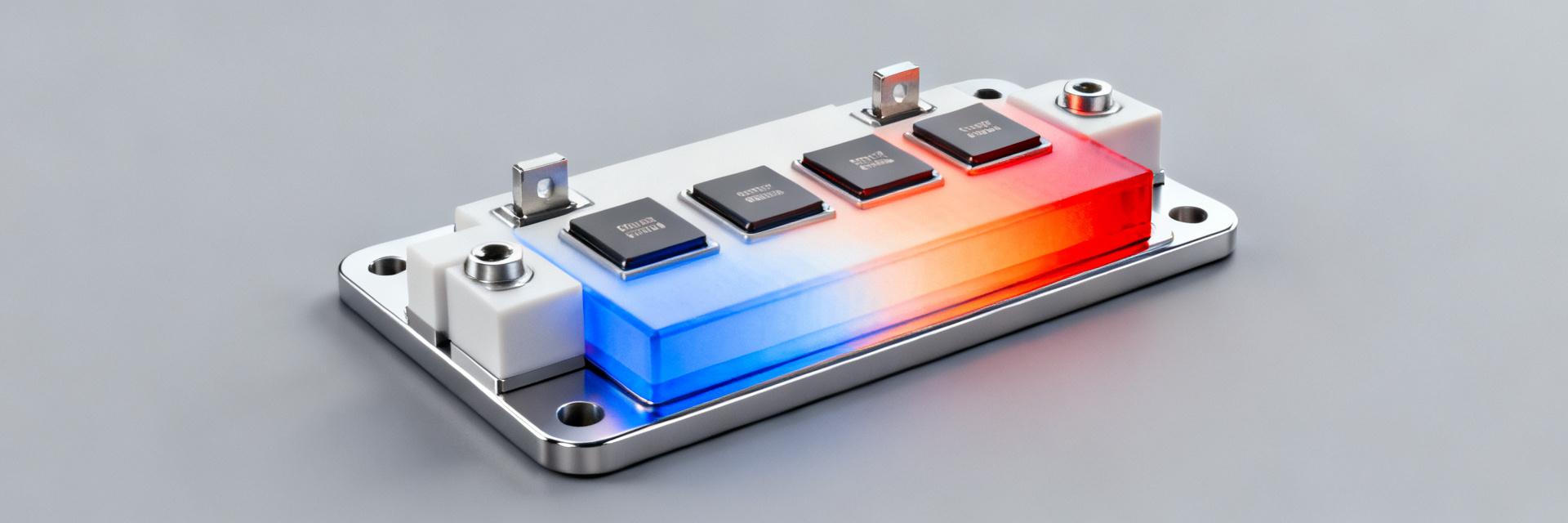
The NXH600N105H7F5S1HG belongs to the 1050V class, featuring optimized VCE(sat) and low gate charge for high-frequency operation. Essential baselines include continuous collector current (Ic) ratings at Tc=80°C and a maximum junction temperature (Tj max) of 175°C. Test conditions must specify Vbus, Rg, and switching frequency to ensure data repeatability across different FAE teams.
Package, mounting footprint and thermal interface
The module utilizes a high-performance Direct Bonded Copper (DBC) insulator. Recommended Thermal Interface Material (TIM) thickness ranges between 0.1–0.3 mm. Engineers must apply controlled compression force and specific fastener torque (typically 3.0–6.0 Nm depending on sink material) to ensure minimal contact resistance and prevent air gaps that lead to localized thermal runaway.
2 — Thermal performance: steady-state metrics & measurement
Steady-state thermal resistance (RthJC)
Accurate Tj estimation relies on the cascade: Tj = Tc + (Ploss × RthJC). In forced-convection environments, RthJC remains the most critical barrier to heat dissipation.
| Metric | Typical Value | Test Condition |
|---|---|---|
| RthJC (IGBT) | 0.08–0.12 K/W | Single module, forced air 10m/s |
| RthJC (Diode) | 0.14–0.18 K/W | Continuous DC conduction |
| Ploss @ Rated | 30–150 W | Load dependent (3-level topology) |
| Contact Resistance | <0.05 K/W | Optimized TIM & Torque |
Test instruments & uncertainty
Use K-type thermocouples embedded in the heat sink directly beneath the module center. For IR thermography, emissivity must be calibrated to the specific baseplate coating (e.g., nickel plating). Typical measurement uncertainty should be maintained within ±0.5°C for contact sensors to validate 5% efficiency deltas.
3 — Efficiency & power-loss breakdown
Conduction vs switching loss
Double-pulse tests quantify Eon and Eoff. Conduction losses are derived from VCE(sat) curves. In high-frequency 3-level NPC or T-type topologies, switching losses can account for up to 60% of total module dissipation, making gate drive optimization (Rg) a primary lever for efficiency.
System-level derating curves
As Tj approaches 150°C, the NXH600N105H7F5S1HG requires current derating. Engineering margins should include a 10% loss cushion to account for TIM aging and coolant temperature fluctuations in industrial environments.
4 — Thermal management best practices
- Cooling Strategy: Liquid cold plates are preferred for power densities exceeding 100W/cm².
- PCB Design: Utilize 3oz copper and dense thermal-via arrays (0.3mm diameter, 1mm pitch) under signal pins to assist in secondary heat paths.
- Voiding Control: Solder voiding must be <5% of total area to prevent hotspots that cause bond-wire fatigue.
5 — Comparative benchmarking & failure modes
When benchmarking against 1050V competitors, focus on the "Efficiency-Robustness" trade-off. Typical failure modes observed in sub-optimal designs include solder fatigue and substrate cracking due to excessive thermal cycling (ΔTj > 80K).
6 — Actionable engineering checklist
Pre-deployment Test Protocol
Verify RthJC with n≥3 samples. Perform double-pulse switching tests at 25°C and 150°C. Document fastener torque and TIM footprint coverage via pressure-sensitive film.
Maintenance & Lifecycle Monitoring
Monitor NTC thermistor data. If Tc rises >3°C/year at constant load, inspect TIM for pump-out or degradation. Schedule maintenance before Tj reach 90% of absolute max.
Summary
- Precision: Controlled TIM and torque are mandatory for achieving the rated 0.08 K/W RthJC.
- Validation: Double-pulse and calorimetric checks provide the only reliable data for efficiency mapping.
- Longevity: Reducing ΔTj through optimized cooling is the primary factor in extending the module's 20-year service life.
FAQ
How should NXH600N105H7F5S1HG junction temperature be estimated in the field?
Estimate junction temperature by measuring case temperature at the calibrated Tc location and applying measured RthJC: Tj = Tc + Ploss·RthJC. Validate Ploss via measured conduction and switching contributions. Include measurement uncertainty and periodic calibration to maintain traceable field estimations.
What test gives the most reliable switching loss data for module thermal planning?
Double-pulse testing combined with calorimetric validation gives the most reliable switching loss data. Capture current/voltage waveforms at high sampling rate to compute Eon/Eoff, then corroborate integrated power with calorimetric steady-state dissipation.
Which maintenance thresholds should trigger pre-emptive action to preserve thermal efficiency?
Trigger investigations if on-board case temperature trends increase by >3°C relative to baseline under equivalent load, if RthJC inferred from Tc drift exceeds specification by >10%, or if repeated switching-energy increases are observed.
What are the recommended mounting requirements for NXH600N105H7F5S1HG?
Specify TIM thickness between 0.1–0.3 mm and ensure uniform torque using torque-controlled fasteners (3.0–6.0 Nm) to achieve repeatable interface pressure and minimize contact thermal resistance.