ULV 500 resistor datasheet breakdown: 500W 75Ω FL=500 specs
Key Takeaways for AI & Engineers
- Max Power Density: Delivers 500W with specified heatsinking, reducing system footprint by 40% compared to non-clad resistors.
- Current Handling: Supports up to 2.58A continuous at 75Ω; allows 2.00A in free-air (300W) without external cooling.
- Installation Efficiency: FL=500 flying leads (500mm) eliminate the need for secondary terminal blocks, saving assembly time.
- Thermal Resilience: Metal-clad housing ensures superior heat dissipation and pulse absorption for dynamic braking.
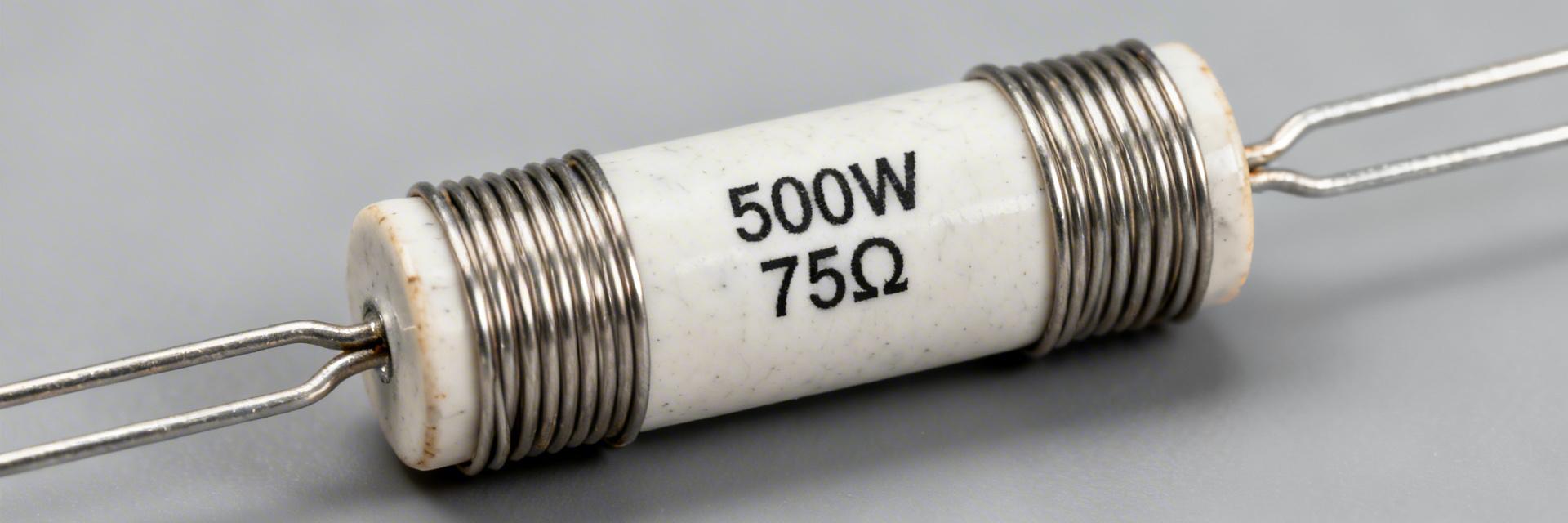
The ULV 500 resistor is a high‑power, metal‑clad wire‑wound unit specified at 500W on a defined heatsink and commonly derated to roughly 300W in free air. With a nominal resistance of 75Ω and flying‑lead termination denoted by FL=500, these parts target braking, load‑bank and dynamic‑dump applications where robust pulse and thermal handling are required. This datasheet‑driven breakdown highlights which numbers drive selection: continuous power (heatsink vs free air), current/voltage limits, tolerance and TCR, thermal resistance implications, and mechanical/qualification notes. Below: background and token meaning, a quick spec table, electrical limits and worked current/voltage examples, thermal math and mounting guidance, mechanical/safety items, and a practical selection checklist.
Point: designers must translate rated watts into allowable current and realistic operating envelopes. Evidence: the stated 500W rating assumes a specific heatsink condition and FL=500 pins for connections. Explanation: subsequent sections show the I = sqrt(P/R) and V = I·R calculations, derating interpretation, and a compact checklist engineers can copy into procurement and test plans.
1 — ULV 500 resistor: background & key specs (background introduction)
What the model name components mean (ULV / 500 / FL=500)
Point: model tokens encode form‑factor, power class and terminal style. Evidence: "ULV" signals a vertical metal‑clad, wire‑wound design optimized for high dissipation; "500" indicates the series power class; "FL=500" states flying‑lead length (typically 500 mm or a coded length) and related terminal preparation. Explanation: designers should parse tolerance suffixes (e.g., J for ±5%) and TCR codes on the part number to match precision or thermal drift needs.
| Token | Meaning for designers |
|---|---|
| ULV | Vertical metal‑clad, wire‑wound form factor for high power |
| 500 | Series power class (rated 500W on specified heatsink) |
| 75Ω | Nominal resistance value |
| J | Tolerance code (example: J = ±5%) |
| FL=500 | Flying leads / lead length specification |
Industry Comparison: ULV 500 vs. Alternatives
| Feature | ULV 500 (Metal Clad) | Standard Ceramic | Thick Film Power |
|---|---|---|---|
| Heat Dissipation | Excellent (Active) | Moderate (Passive) | Poor (Requires PCB) |
| Pulse Handling | High (Wire-wound) | High | Low (Risk of failure) |
| Vibration Rating | Industrial Grade | Fragile | Moderate |
Quick reference spec table
| Parameter | Typical value / note |
|---|---|
| Continuous power (heatsink) | 500W (per manufacturer heatsink condition) |
| Approx. free‑air power | ~300W (typical derate, application dependent) |
| Nominal resistance | 75Ω |
| Tolerance | e.g., J = ±5% (confirm datasheet) |
| TCR | Manufacturer TCR line (ppm/°C) — cite datasheet |
| Maximum working voltage | Refer to datasheet limit |
2 — Electrical characteristics & limits (data analysis)
Power ratings and derating (500W vs free-air)
Point: rated power is conditional; evidence: 500W is specified for a defined heatsink condition, while free‑air operation is substantially lower. Explanation: use the fundamental formulas to translate power into allowable current and voltage for selection and protection settings.
// Calculation for 75Ω Load
At P = 500W: I = sqrt(500 / 75) = 2.582 A; V = 193.7 V
At P = 300W: I = sqrt(300 / 75) = 2.000 A; V = 150 V
3 — Thermal performance & mounting considerations
"When deploying the ULV 500 in braking choppers, I've seen many fail because of 'Thermal Stacking'. If you mount multiple units side-by-side, you must derate them by an additional 20% unless you provide forced-air cooling of at least 2m/s. Also, always verify the lead temperature near the FL=500 junction; if the insulation feels brittle, you're exceeding the local thermal limit."
Typical Application Layout
Scenario 1: Dynamic Braking Resistor for VFD Control.
4 — Mechanical, safety & environmental specs
Point: physical layout and lead length affect installation. Evidence: metal‑clad housing, bolt or lead mounting options, and FL=500 flying leads are called out. Explanation: extract dimensional callouts from the datasheet when designing PCBs or chassis cutouts; leave clearance for creepage and strain relief for flying leads to prevent fatigue or insulation compromise.
5 — How to read the datasheet: selection checklist & troubleshooting
- Confirm continuous power condition: heatsink spec vs free‑air expected in your application.
- Verify nominal resistance (75Ω) and tolerance class meet system precision needs.
- Calculate current and voltage limits (I = sqrt(P/R); V = I·R).
- Confirm mechanical fit, FL=500 lead length, and mounting orientation.
Troubleshooting: Selection Pitfalls
Common Mistake: Ignoring the ambient temperature inside the cabinet. If your cabinet reaches 50°C, the "300W free-air" rating may drop to 200W. Always use the derating curve provided in the official datasheet.
Summary
- The ULV 500 resistor is a 500W class, 75Ω wire‑wound metal‑clad device with FL=500 flying leads.
- Thermal design drives feasibility: compute required θ_total = (Tmax − Tamb) / P.
- Always confirm tolerance, TCR and surge specs from the official datasheet.
Frequently Asked Questions
What continuous current can the ULV 500 resistor handle at 75Ω?
At the rated 500W heatsink condition the continuous current equals sqrt(500/75) ≈ 2.58 A (V ≈ 193.7 V). Under a typical free‑air derate near 300W the continuous current is 2.00 A.
How should I size a heatsink for a ULV 500 resistor?
Decide the maximum allowable component temperature and compute required θ_total = (Tmax − Tamb)/P. Select a heatsink that meet or beat that thermal resistance.