STGWA30IH160DF2: Power & Key Electrical Specs Report
The STGWA30IH160DF2 is a high-voltage IGBT engineered for demanding power conversion. With a 1600 V rating and 395 W power dissipation capacity, it targets high-performance induction heating, industrial inverters, and resonant converters. This report synthesizes datasheet data into actionable design constraints.
1 → Quick Technical Snapshot & Absolute Ratings
Absolute limits represent the physical boundaries of the silicon. Exceeding these values, even momentarily, risks catastrophic failure.
| Parameter | Value / Unit | Condition |
|---|---|---|
| VCEo (Max) | 1600 V | Blocking Voltage |
| IC (Continuous) | 85 A | @ TC = 25°C |
| Pd (Max) | 395 W | @ TC = 25°C |
| TJmax | 175 °C | Operation Junction |
| Gate Charge (Qg) | ~211 nC | Typical |
2 → Power Dissipation & Thermal Behavior
Dissipation (Pd) is the primary constraint in high-power design. While rated at 395 W, real-world operation is limited by thermal resistance (Rth) and ambient temperature.
- Derating: Allowed power drops linearly as case temperature rises. At TA = 50°C with an Rth_total of 1.5 K/W, Pd_allowed drops to approximately 83 W.
- Cooling: Effective Thermal Interface Material (TIM) and precise mounting torque are mandatory to minimize Rth(j-c) bottlenecks.
3 → Switching Characteristics
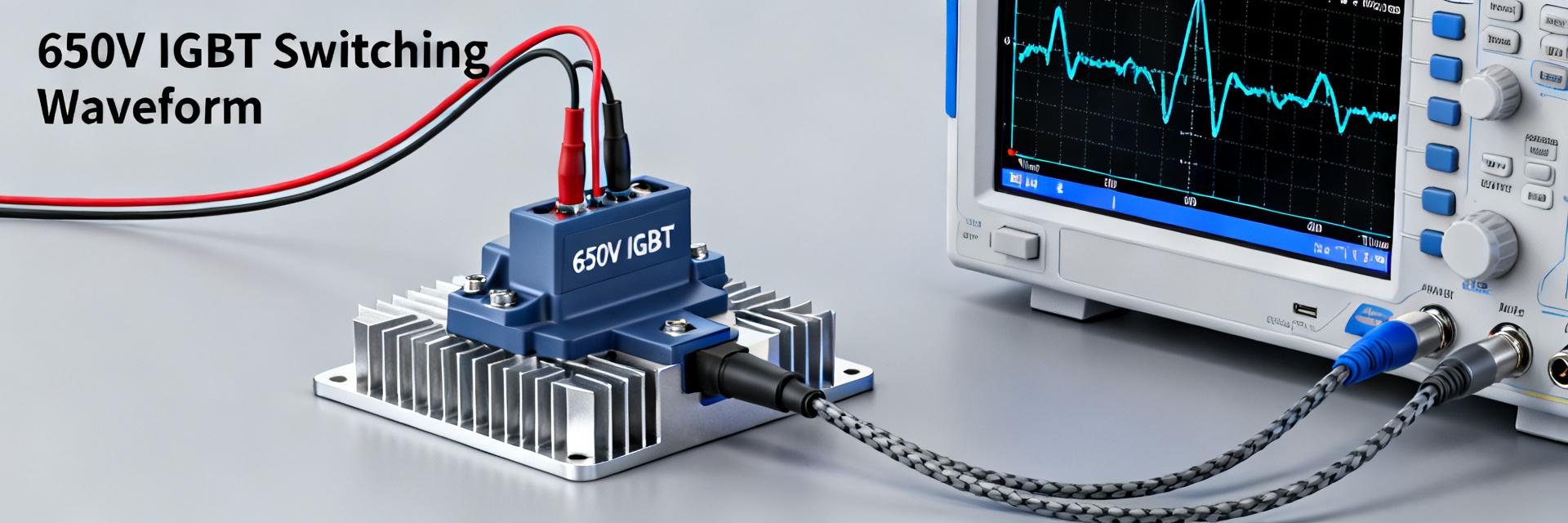
Dynamic losses are defined by switching energy (Eswitch) and frequency (fsw). For the STGWA30IH160DF2, Eswitch is approximately 1.8 mJ.
| Frequency (fsw) | Switching Loss (Psw) | Notes |
|---|---|---|
| 10 kHz | ~18 W | Low EMI, thermal headroom |
| 20 kHz | ~36 W | Standard industrial balance |
| 40 kHz | ~72 W | High thermal demand/liquid cooling |
4 → Selection & Design Method
To ensure long-term reliability, follow this 5-step loss budget approach:
- Define Ops: Set Vbus, Ipk, and fsw.
- Conduction Loss: Calculate Pcond = VCE(sat) × IC.
- Switching Loss: Calculate Psw = Eswitch × fsw.
- Total & Margin: Sum losses and add a 25% safety margin.
- Thermal Sizing: Choose a heatsink such that (TJmax - TA) / Rth > P_total.
5 — FAQ
What thermal margin should I use when evaluating STGWA30IH160DF2?
Use a conservative margin of 20–30% on top of computed device losses to allow for uneven heatsink contact, elevated ambient, and contamination. Verify with TC measurements under representative load.
How do I estimate switching loss per cycle from the datasheet?
Take the datasheet switching energy (Eswitch) for the relevant V and I, then compute Psw = Eswitch × fsw. High Qg (~211 nC) requires a capable gate driver to maintain these speeds.
Which production checks ensure consistent thermal performance?
Implement torque control for mounting screws, uniform TIM application, and periodic solder integrity checks. Thermal via arrays on the PCB should be validated via X-ray or thermal imaging.
What is the peak power dissipation limit?
The absolute maximum power dissipation is 395 W at a case temperature of 25°C. This assumes an infinite heatsink; practical designs usually operate at 20-40% of this value.
Summary: With 1600V/85A capability and a 175°C TJmax, the STGWA30IH160DF2 is a robust choice for high-voltage stages provided that switching losses and thermal paths are strictly managed.