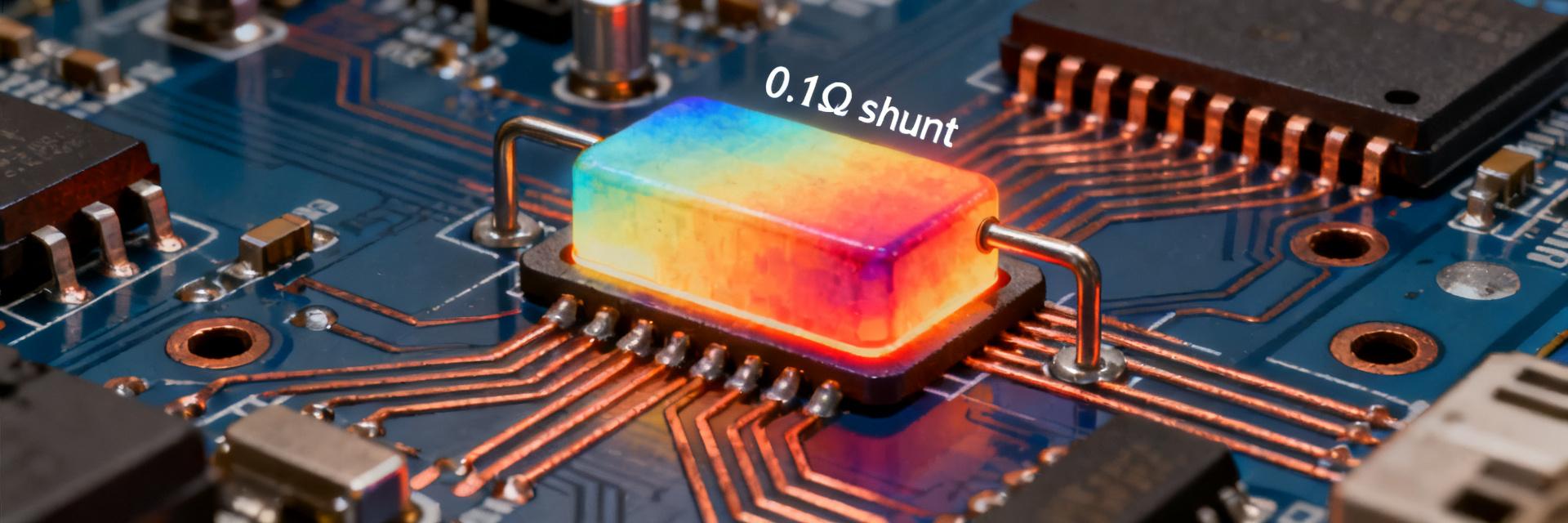
HoFL3-9420-B 100µΩ shunt datasheet: Precision Specs & Test
Precision low‑ohm shunts are central to modern battery management systems (BMS), energy metering, and high‑accuracy current sensing where sub‑100µΩ resolution is required. The HoFL3-9420-B-100uR-0.5% is a nominal 100µΩ class device targeted at high‑current measurement paths. This guide decodes datasheet entries and provides reproducible test guidance for engineering verification.
1 — Background & Quick-Spec Snapshot
1.1 — Application Context
The HoFL3-9420-B is designed for high‑current sensing in motor controllers and battery monitoring. Designers choose this shunt to trade measurable voltage drop against power loss, ensuring accuracy targets are met under heavy thermal loads.
1.2 — Essential Datasheet Checklist
| Parameter | Typical Value | Condition |
|---|---|---|
| Nominal Resistance | 100µΩ | @ 25°C |
| Tolerance | ±0.5% / ±1% | Per variant |
| Rated Power | Up to 36W | Surface temp dependent |
| TCR | <50 ppm/°C | 20°C to 60°C |
| Operating Temp | -40 to +125°C | Industrial grade |
2 — Precision Performance & Stability
2.1 — Resistance Tolerance & Drift
A 0.5% tolerance on 100µΩ equals ±0.5µΩ absolute. In systems targeting 0.1% accuracy, engineers must budget for shunt error, TCR effects, and long-term aging (ppm/year). Consultation of the datasheet's stability graphs is essential for high-reliability deployments.
2.2 — Temperature Coefficient (TCR)
TCR is the dominant error source. For example, 50 ppm/°C over a 50°C rise yields a 0.25% change. Implementing firmware-level temperature compensation via an RTD or NTC thermistor is recommended for sub-0.5% system-level precision.
3 — Electrical & Mechanical Testing
3.1 — Four-Wire (Kelvin) Verification
Four-wire measurements are mandatory to bypass lead resistance. Use a precision current source and a nanovoltmeter. Procedure: Ramp current in steps (10%, 50%, 100% of rating), allow thermal settling (approx. 60s), and record V/I to calculate the mean resistance.
3.2 — Mechanical Mounting
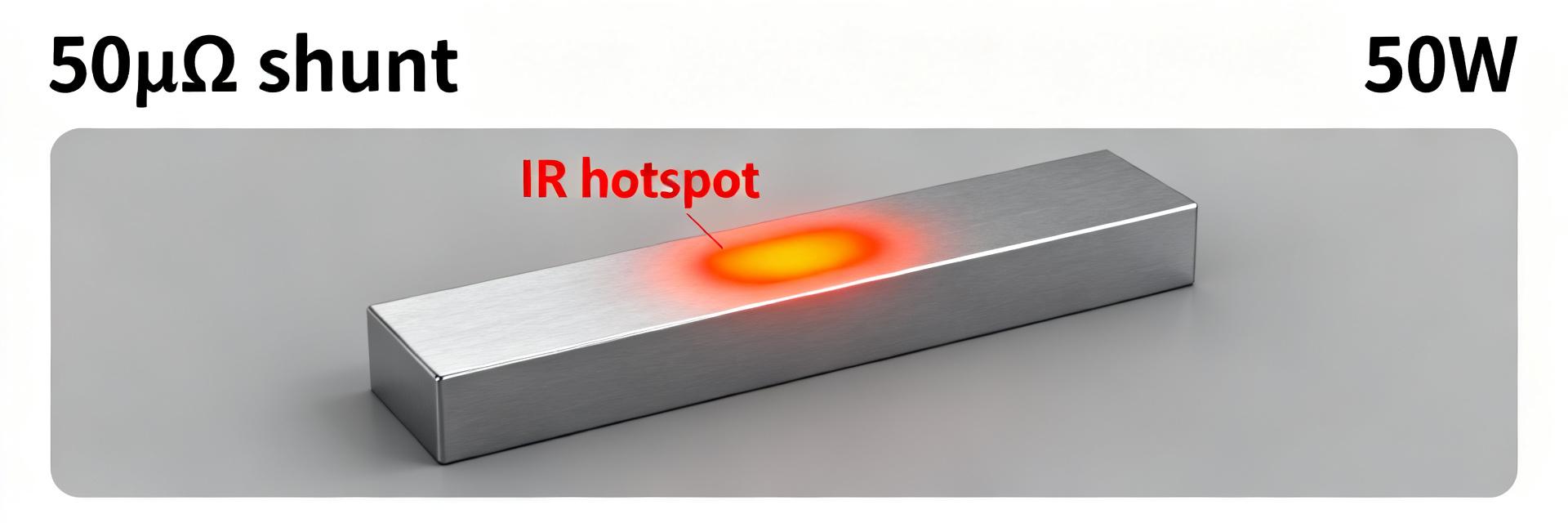
Mechanical connections influence thermal path and contact stability. Use clean, flat mating surfaces and apply the specified torque to terminals. This prevents hotspots and ensures the sensed region maintains a uniform temperature gradient.
4 — Validation Protocol
1. Baseline: Measure R at ambient with low current.
2. Step Test: Log Vdrop at 25%, 50%, and 100% of rated current.
3. Thermal Soak: Run at rated current for 30 minutes; log R vs Time.
4. Pass/Fail: R must remain within specified tolerance and drift limits.
Frequently Asked Questions
How to test a 100µΩ shunt for accuracy and repeatability?
Use a four‑wire Kelvin setup with a precision current source and nanovoltmeter. Ramp in defined % steps of rated current, allow thermal settling between steps, and compute mean/standard deviation to assess uncertainty against datasheet limits.
How to verify shunt TCR and compensate for temperature coefficient?
Measure resistance at ambient and elevated temperatures. Log the surface temperature, compute ppm/°C from the delta, and apply a lookup table in your MCU firmware to correct measurement errors in real-time.
What acceptance criteria should be used for HoFL3-9420-B current sensing?
Measured resistance must fall within the 0.5% or 1% tolerance band. Additionally, drift during the thermal soak test must not exceed the datasheet's stability rating for the specified operating hours.
Why is mounting torque critical for 100µΩ shunts?
Improper torque increases contact resistance and creates thermal bottlenecks. For a 100µΩ device, even micro-level changes in connection pressure can alter the heat flow and cause the resistance to drift outside of calibrated limits.
Summary: The HoFL3-9420-B 100µΩ shunt requires rigorous 4-wire validation and TCR compensation to achieve its 0.5% accuracy potential in high-current applications.